Austin Home Austin Home

Why Is LED Lighting Best for Kitchen Worktops?

Time:2026-11-04 Author:Liam
0%

Kitchen worktops handle more than food preparation. They are where you chop herbs, read recipe notes, and check whether a sauce has browned. A single ceiling light can leave hands casting shadows across the counter. LED lighting offers a practical way to bring light closer to these everyday tasks.

So, what is the best lighting for kitchen worktops? In many kitchens, well-positioned LED strips or low-profile task lights beneath cabinets provide even illumination without taking up counter space. The right choice depends on cabinet layout, worktop finish, and how you use the room. A light with a suitable colour rendering index can make ingredients look more natural, while a comfortable colour temperature helps the space feel inviting. Small details matter.

Glare matters, too. A glossy stone surface may reflect a bright strip directly into your eyes, so diffusers and careful placement are worth considering. Look for products with clear performance and safety information, especially near sinks or other damp areas, and follow the manufacturer’s installation guidance. Specifications do not tell the whole story. A light that looks excellent in a showroom may feel too cool at home; I would test the effect before committing to a full installation. This guide explores why LED lighting is often a strong choice, what features to compare, and how to create a brighter, more comfortable worktop without overcomplicating the kitchen.
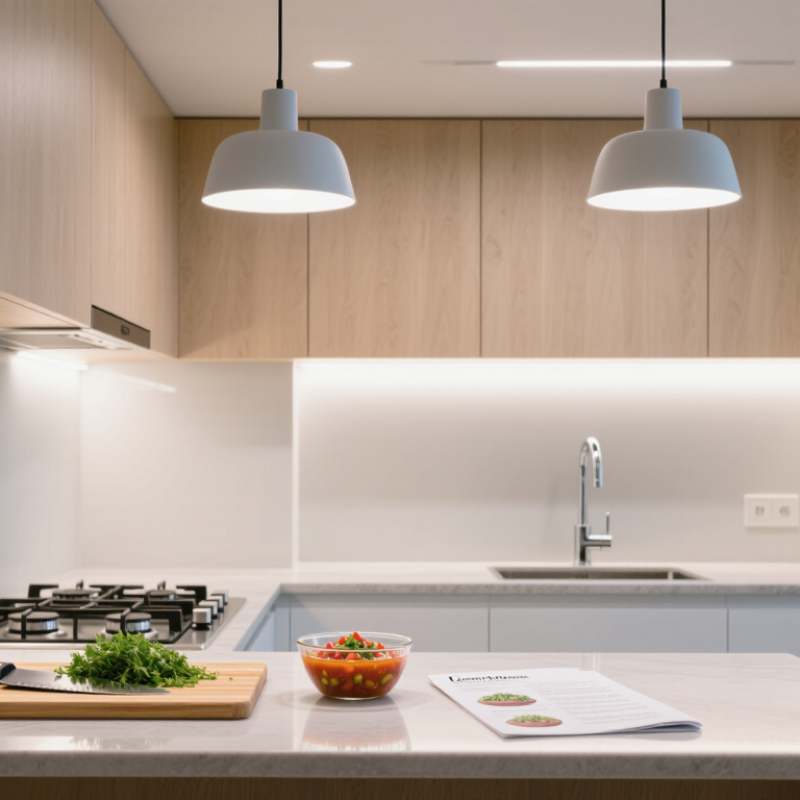
Why Is LED Lighting Best for Kitchen Worktops?

What Kitchen Worktop Lighting Needs to Provide

Why Is LED Lighting Best for Kitchen Worktops?

What Kitchen Worktop Lighting Needs to Provide

Worktop lighting should reveal knife edges, ingredient color, and small spills without casting your hands’ shadows across the cutting board. EN 12464-1:2021 gives 500 lux as a benchmark for food-preparation areas. Treat it as a useful reference, not a promise of comfort: a lux reading cannot show whether the corner beside your sink still feels gloomy. Choose an even spread of light, good color rendering, and a shielded fixture that limits glare on polished stone. A color rendering index (CRI) of 90 or higher can help foods and surfaces look more natural.

LEDs suit this task because they provide efficient, controllable light in compact fittings. The U.S. Department of Energy reports that residential LEDs use at least 75% less energy and last up to 25 times longer than incandescent lighting. Those figures are comparisons, not guarantees for every fitting; heat, ventilation, and switching habits affect service life. Under-cabinet LEDs also need careful placement, since a bright strip aimed directly at glossy counters can create distracting reflections.

Tips: Test the light after dark. Chop a tomato, read a recipe, and check the counter from your usual standing position. If your body blocks the beam, move the fitting nearer the cabinet front. Small adjustment, big difference.

How LED Lighting Illuminates Kitchen Worktops

Why Is LED Lighting Best for Kitchen Worktops?

How LED Lighting Illuminates Kitchen Worktops

LED strips beneath upper cabinets send light directly onto worktops, where chopping, reading labels, and measuring ingredients happen. Close placement reduces shadows cast by a cook’s hands. Position the strip near the cabinet’s front edge, and use a diffuser to soften bright points. Small changes matter.

Choose a high-color-rendering light, ideally CRI 90 or above, to judge herbs, meat, and ripeness more naturally. A neutral-white 3,000–4,000 K tone often gives clear visibility without feeling stark, though personal preference matters. IES guidance distinguishes task lighting from ambient lighting; worktops benefit from their own controlled layer, rather than ceiling light alone. A dimmer helps adjust brightness for different tasks.

Glossy stone can reflect LEDs into your eyes, so check the light while standing and seated. Matte finishes tend to scatter it more evenly. U.S. Department of Energy guidance reports that LEDs use at least 75% less energy than incandescent lamps and last up to 25 times longer. This efficiency can support regular task lighting, but it cannot fix poor placement: even bright LEDs leave dark patches when cabinets block the beam.

Benefits of LEDs for Food Preparation and Everyday Tasks

For food preparation, useful light needs to land on the worktop, not in your eyes. A continuous LED strip beneath wall cabinets can reduce shadows from your body and make chopping, reading small print, and spotting crumbs easier. Choose a diffuser to soften bright points, and position the light toward the counter’s front edge. Small detail. It matters.

Color matters too. A high color-rendering index, such as CRI 90 or above, can make herbs, meat, and ripe tomatoes look closer to their natural colors. It helps with visual checks, though it cannot tell you whether food is fresh or safe. The U.S. Department of Energy’s Energy Saver guidance reports that LEDs use at least 75% less energy and last up to 25 times longer than incandescent lighting. Those figures compare lamp technologies; actual savings depend on use and installation. Dimming is handy for evening cleanup, but very cool or overly bright light can feel harsh against pale counters. I would test the tone at home before fitting a full run. Lamps and surfaces can look different in a showroom.

Why Is LED Lighting Best for Kitchen Worktops? – Benefits of LEDs for Food Preparation and Everyday Tasks

Worktop consideration Useful measure or range Practical LED approach Benefit for food preparation and everyday tasks
Illumination on the work surface Around 500 lux is a useful target for detailed kitchen tasks; actual needs vary with the task and user. Position under-cabinet lights to illuminate the counter evenly, and check light levels at the work surface. Makes chopping, reading labels, and measuring ingredients easier to see.
Colour appearance A colour rendering index (CRI) of 90 or higher is a useful choice when accurate colour appearance matters. Choose a high-CRI LED for the main food-preparation area. Helps food colours look more natural when checking ripeness and appearance.
Light colour and comfort About 3000–4000 K is a common range for a balanced, comfortable kitchen task light. Keep the worktop lighting colour consistent with nearby kitchen lighting where possible. Provides clear task lighting without an overly warm or stark appearance.
Shadows and glare There is no single suitable spacing for every kitchen; results depend on cabinet depth, fixture position, and worktop layout. Place lights toward the front of the cabinets and use a diffuser or shield if individual LEDs are visible. Reduces distracting reflections and shadows cast by the person working at the counter.
Energy use LEDs use substantially less electricity than incandescent lighting for comparable light output; savings depend on the products being compared and hours of use. Compare lumens and wattage rather than wattage alone when choosing a replacement. Provides useful task light with lower electricity consumption than traditional incandescent lamps.
Service life and maintenance Many LED products are rated for approximately 25,000–50,000 hours, though ratings vary by product and operating conditions. Check the stated lifetime and whether the light source or driver can be replaced. Long-rated products can mean fewer lamp changes in frequently used work areas.
Everyday flexibility Dimming is available on many LED systems, but the driver, dimmer, and light must be compatible. Use a compatible dimmable setup if you want bright task light and lower light levels at other times. Lets one lighting installation support food preparation, tidying, and relaxed evening use.
Installation near water Required protection depends on the fixture location and local electrical rules. For areas near sinks, select fixtures suitable for the location and follow local electrical guidance. Helps ensure the chosen lighting is appropriate for the kitchen environment.

Figures are practical guidance, not guarantees. Light output, lifetime, energy savings, and suitability depend on the specific product, installation, and conditions of use.

Choosing LED Color, Brightness, and Placement

Why Is LED Lighting Best for Kitchen Worktops?

Choosing LED Color, Brightness, and Placement

LEDs make it easier to tune worktop lighting to real kitchen tasks. Color temperature changes how the space feels. Around 3000 K gives warm, soft light, while 3500–4000 K looks more neutral and can make food details easier to see. For chopping and checking ingredients, a high color-rendering index, ideally 90 or above, helps colors appear more natural. Numbers are useful, but samples viewed in your own kitchen tell you more.

Brightness matters just as much. A work surface often benefits from roughly 500 lux, though dark counters and limited daylight may need more. Dimmable LEDs let you reduce output for evening use. Small detail. Avoid staring into exposed LED points; a diffuser creates a smoother line of light and reduces glare.

Placement can make or break the result. Under-cabinet lights should sit near the front edge, aimed down the counter, so your body does not cast a shadow while you work. Keep the light continuous around sinks and prep areas, and check for dark gaps before fixing anything permanently. I still find brightness easy to misjudge from product numbers alone. Tape a temporary light in place and test it while chopping; the reflection on a glossy counter may reveal a problem you missed.

Why Is LED Lighting Best for Kitchen Worktops?

LEDs make it easy to add efficient, focused task lighting and choose a color temperature that suits your kitchen.

Choosing color, brightness, and placement: Use around 300–400 lux as an indicative target for worktops, with brighter light for detailed food preparation. A color temperature of 3000–4000 K gives a clear, neutral-to-warm appearance. Place under-cabinet lights toward the front of the cabinet to illuminate the work surface and reduce shadows. Targets vary with room design and personal preference.

Installing and Maintaining Worktop LED Lighting

For even light across a kitchen worktop, plan the LED strip position before fixing anything. A strip set too far back can leave the counter edge dim; one placed too near the front may shine into your eyes. Hold a temporary light in place and check the sink, chopping area, and corners after dark. Small details matter. Measure each cabinet section, then cut only at the marked points on the strip. A slim aluminium channel with a diffuser helps protect the LEDs and soften bright spots. Clean and dry the surface before attaching it, since grease can weaken the adhesive. A neat first plan can still miss a shadow near the tap.

Choose lighting suited to the kitchen’s moisture and heat conditions, and keep the power supply accessible for inspection. Follow the product instructions, and have a qualified electrician handle any mains wiring. Low-voltage connections still need to be installed carefully. Once fitted, switch off the power before cleaning. Wipe the channel with a soft, slightly damp cloth; avoid abrasive pads and sprays that can reach the connections. Check occasionally for loose sections, damaged cables, or flickering. If a strip starts peeling, replace or refit it rather than pressing it back onto a greasy surface. I would not hide the driver behind a sealed panel; servicing it later is easy to forget.

FAQS

What should kitchen worktop lighting help me see?

It should reveal knife edges, ingredient colors, and small spills. Aim for even light without shadows from your hands.

How bright should worktop lighting be?

Around 500 lux is a useful food-preparation benchmark. Dark counters or limited daylight may need more. Check the actual work surface.

Why are LEDs a practical choice?

LEDs use less energy than incandescent lighting and can last longer. Real performance depends on heat, ventilation, and switching habits.

What LED color temperature works well for food preparation?

Around 3500–4000 K gives a neutral look that can help show food details. Around 3000 K feels warmer and softer.

What does a high CRI do?

A CRI of 90 or higher can make herbs, meat, and tomatoes look more natural. It cannot confirm freshness or food safety.

Where should under-cabinet lights be placed?

Position them near the cabinet’s front edge, aimed down across the counter. This can reduce shadows from your body. Small detail.

How can I reduce glare on a glossy counter?

Use a diffuser to soften bright points. Aim the light carefully, since polished stone can reflect exposed LEDs.

How can I test the lighting before installation?

Tape a temporary light in place and test it after dark. Chop a tomato and read a recipe from your usual position. I still find brightness easy to misjudge.

Conclusion

Good kitchen worktop lighting should provide clear, even illumination across food preparation areas while reducing shadows and glare. LED lighting is well suited to this task because it delivers focused light efficiently and can be placed beneath cabinets or along shelving to brighten the surface where everyday work happens. Better visibility can make chopping, measuring, and cleaning easier and more comfortable.

When deciding what is the best lighting for kitchen worktops, consider the color and brightness of the light, the size and layout of the worktop, and where fixtures will provide the most even coverage. A neutral or warm-white tone can create a pleasant, practical workspace, while suitable brightness helps reveal details without feeling harsh. Careful installation, secure positioning, and occasional cleaning help maintain consistent performance and keep the lighting useful over time.

Liam

Liam

Liam is a dedicated marketing professional with a profound expertise in the industry, where he excels at highlighting the unique advantages of our core products. With a keen understanding of market trends and consumer needs, Liam frequently updates our company’s professional blog, providing......